04/05/2008
Waftaroms, indotherms and the graphic language of cartooning

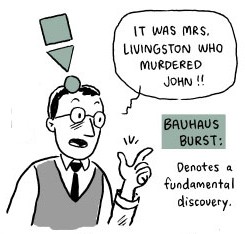
Don't know a grawlix from a plewd or an agitron from an indotherm? Finding words for the marks made by cartoonists is a funny business. A jokey article about the marks cartoonists make for things like movement, emotion and radiation is now the stuff of earnest research into the visual language of cartoons.
It seems to have started with American cartoonist Mort Walker who wrote a satirical article in 1964 called "Let's Get Down to Grawlixes," for the National Cartoonists Society. In 1980 he expanded it to a book The lexicon of comicana. In Mort Walker's Private Scrapbook he writes:
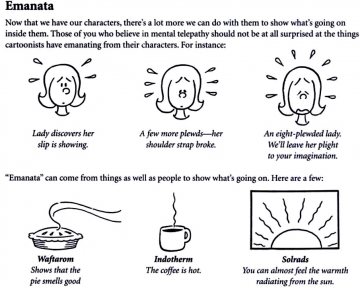
'I spoofed the tricks cartoonists used, like dust clouds when characters are running or lightbulbs over their heads when they get an idea... I spent many hours at the museum recording their "language". I created pseudoscientific names for each cartoon cliché, like the sweat marks cartoon characters radiate. I called them "plewds" after the God of rain "Joe Pluvius".'
The spoof didn't quite work (even though the words he invented are very funny), because people really wanted words for the marks cartoonists make. So here is a run-down, from Wikipedia:
- Plewds Flying sweat droplets that appear around a character's head when working hard or stressed.
- Briffits Clouds of dust that hang in the spot where a swiftly departing character or object was previously standing.
- Squeans Little starbursts or circles that signify intoxication, dizziness, or sickness.
- Emanata Lines drawn around the head to indicate shock or surprise.
- Grawlixes Typographical symbols standing for profanities, which appear in dialogue balloons in the place of actual dialogue.
- Indotherm Wavy, rising lines used to represent steam or heat on hot objects -- however, the same shape found over a hot apple pie or something else strong smelling is a wafteron.
- Agitrons Wiggly lines around an object that is shaking
- Blurgits, swalloops Curved lines preceding or trailing after a character's moving limbs
- Hites Horizontal straight lines trailing after something moving with great speed, or indicating reflectivity (puddle, glass, mirror). Likewise, up-hites would be lines above an object falling.
- Lucaflect A shiny spot on a surface of something
- Dites Diagonal, straight lines drawn across something flat, clear, and reflective, such as windows and mirrors.
- Solrads Radiating lines drawn from something luminous like a lightbulb or the sun.
- Vites Vertical straight lines indicating reflectivity (compare dites, hites)
It's funny in a Sellars & Yeatman kind of way (something else that deserves to be better known). Dash Shaw responded to the comic challenge with a great cartoon strip using the symbols and The Balloonist drew a booklet for cartoonists using some new symbols. Needless to say, the academically minded take it all very seriously. Neil Cohn just about gets the point. But only just:
'He also attaches a myriad of useless names to them, to the extant that you feel that his whole point for jargon is to be facetious (which it may well have been).'
See also an explanation of Kirby Dots (developed by Jack Kirby to show an energy explosion) and a site devoted to cataloguing onomatopoeia like 'kaboom' (apparently first used in The incredible hulk, vol 1, no. 229, 1978).
18:50 Posted in Web | Permalink | Comments (0) | Trackbacks (0) | Email this
22/02/2008
The power of ornament
Web find of the month is a site devoted to complete reproductions of illuminated books. It includes Owen Jones' astonishing Grammar of Ornament (1856), a tour de force of nineteenth century letterpress and chromolithographic printing which has had an incalculable influence on artists and designers from the Art Nouveau to Gaudi in Barcelona.
Owen Jones' most influential book contains his own re-drawing on 'scientific' principles of over 2,000 decorative designs. The scope is vast: from designs created by 'savage tribes' to ornament from the ancient world, Arabia, China, India and Europe. The motifs presented range from intricate and highly elaborate high Renaissance manuscript illumination to apparently simple geometric tile designs from Moorish Spain and Persia.
A passion for the orient
Jones (1809-74) was an architect who became passionate about the superiority of non-European ornament after touring Turkey, Egypt, Sicily and Spain in 1831. Henry Cole, who founded the Victoria & Albert Museum, was one of his many collaborators.
Jones' passion for the near east found expression in his most significant work as an architect on the interior of Christ Church, Streatham. He was criticised for his 'excessive use' of Islamic motifs there.
Acclaimed for his decorations for the Great Exhibition in 1851, Jones worked for nine years on the publication of a lavish folio work, which exploited the capabilities of the relatively new and demanding process of chromolithography. He sold property to finance its publication, setting up his own press and training his own staff to produce it. He did not live to see it succeed commercially, and many copies were remaindered.
Besides including a historical survey and commentary on the many gorgeous full page colour illustrations, Jones developed a series of 37 'design propositions' which attempted to codify the construction of well-made ornament. For Jones: 'All ornament should be based on geometrical construction' And 'true beauty results from that repose which the mind feels when the eye, the intellect, and the affections, are satisfied from the absence of any want'. In his final chapter he advocated a new kind of architecture based on natural forms.
There is an enduring appeal in many of these stunning illustrations. They combine a remarkable and carefully constructed rhythmic intensity with a highly developed colour palette. Since the Modern Movement, architects and designers have associated ornament with the literally superficial, seeing it as a layer of irrelevant decoration that obscures the underlying nature of whatever it is applied to.
For me and I suspect for Jones, the desire to decorate is an integral part of human experience. His use of geometric reconstruction seems to link to metaphysical ideas of the golden section or 'divine proportion' which were taken up by Modern Movement architects such as Le Corbusier.
Good ornament is intrinsic to the very essence of things.
The Grammar of Ornament on CD-ROM for designers.
14:30 Posted in Web | Permalink | Comments (0) | Email this